
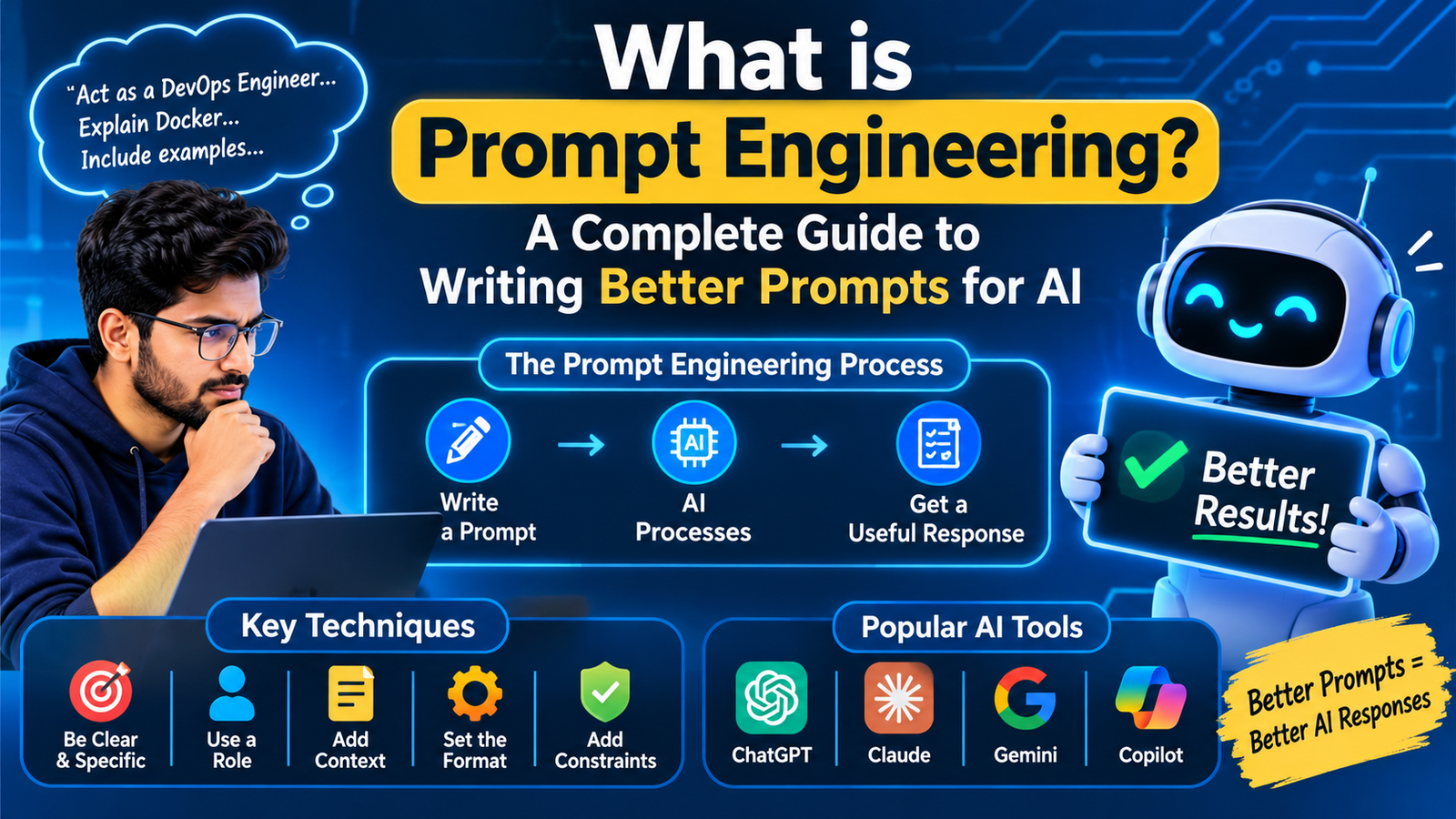
Introduction:
Prompt Engineering is becoming one of the most important skills in the world of Artificial Intelligence (AI). Today, AI tools such as ChatGPT, Claude, Google Gemini, and Microsoft Copilot are transforming how people work, learn, develop software, and automate business processes.
Prompt Engineering is the process of designing and writing effective instructions to get accurate, relevant, and useful responses from AI tools.
In simple words, Prompt Engineering means asking AI the right questions in the right way to achieve the desired results.
For example, instead of simply asking AI to explain Docker, we can provide detailed instructions about our experience level, topics, and expected output. This helps AI understand our requirements better.
1. What is a Prompt?
A prompt is an instruction, question, or command provided to an AI model to generate a response.
Prompts can include:
- Questions
- Instructions
- Text
- Code
- Images
- Documents
- Examples
Example:
Basic Prompt:
Explain Kubernetes.Advanced Prompt:
Act as an experienced DevOps Engineer.

Explain Kubernetes architecture
for beginners.

Include:
1. What is Kubernetes?
2. Kubernetes components
3. Master and worker nodes
4. Pods and deployments
5. Practical commands
6. Real-world examples

Use simple English and explain step by step.
The advanced prompt gives AI more context and specific instructions.
2. How Does Prompt Engineering Work?
From Prompt Engineering to Context Engineering: The AI Revolution You Need to Know About – DEV Community
Prompt Engineering follows a simple workflow:
- User Input: The user provides a prompt or instruction.
- AI Processing: The AI model processes the given information.
- Understanding Context: AI uses the available context to interpret the request.
- Response Generation: AI generates an answer based on its training and input.
- Review and Improvement: The user reviews the output and improves the prompt if required.
This process helps users obtain more useful results from AI tools.
3. Key Components of Prompt Engineering
An effective prompt generally contains five important components.
1. Role
Define which role AI should perform.
Example:
Act as a Senior DevOps Engineer.2. Task
Clearly explain what you want AI to do.
Example:
Explain Docker architecture.3. Context
Provide background information about your requirements.
Example:
I am a beginner learning DevOps.4. Format
Specify how you want the output.
Example:
Explain in bullet points with practical examples.5. Constraints
Define limitations or specific requirements.
Example:
Use simple English and keep the explanation within 500 words.Combining these components helps create more effective prompts.
4. Types of Prompt Engineering Techniques
Prompt Engineering Guide: Techniques, Examples & Skills
1. Zero-Shot Prompting
Zero-shot prompting means asking AI to perform a task without providing examples.
Example:
Explain the difference between Docker
and Kubernetes.
2. Few-Shot Prompting
Few-shot prompting means providing a few examples before asking AI to perform a task.
Example:
Convert these sentences into professional English.

Example:
Input: I need leave tomorrow.
Output: I would like to request leave for tomorrow.

Now convert:
Input: I will complete the task today.
3. Chain-of-Thought Prompting
This technique encourages AI to break complex problems into smaller steps and provide a structured explanation.
Example:
Analyze this Jenkins pipeline failure.
Break down the possible causes
and explain the troubleshooting steps.
4. Role-Based Prompting
Role-based prompting means assigning a specific role to the AI.
Example:
Act as a Linux System Administrator.
Explain Linux file permissions
with practical commands.
5. Contextual Prompting
Contextual prompting means providing relevant background information before asking a question.
Example:
I have a Spring Boot application
running inside Docker.

The application cannot connect
to the MySQL database.

Explain possible causes and solutions.
6. Iterative Prompting
Iterative prompting means improving a prompt based on the previous AI response.
Example:
- First prompt: Explain Docker.
- Second prompt: Explain Docker networking.
- Third prompt: Give practical Docker networking commands.
5. Real-World Applications of Prompt Engineering
Prompt Engineering is useful in different technical and non-technical fields.
GPT-5.5 AI Model Explained (Features, Use Cases & Comparison) | WoHoTech
Software Development
- Generate code.
- Debug programming errors.
- Explain complex code.
- Create test cases.
DevOps and Cloud Computing
- Generate Dockerfiles.
- Create Jenkins pipelines.
- Write Ansible playbooks.
- Generate Terraform configurations.
- Troubleshoot Kubernetes errors.
Content Creation
- Write technical blogs.
- Generate SEO titles.
- Create social media content.
- Prepare documentation.
Business Automation
- Generate professional emails.
- Create reports.
- Summarize documents.
- Automate repetitive tasks.
6. Practical Prompt Engineering Examples for DevOps Engineers
Here are some practical prompts that DevOps engineers can use in their daily work.
Example 1: Docker
Act as a Docker expert.

Create a Dockerfile for a
Spring Boot application using Java 17.

Explain every instruction.
Also provide Docker build and run commands.
Example 2: Jenkins CI/CD Pipeline
Act as a Jenkins expert.

Create a Jenkins declarative pipeline
for a Spring Boot application.

Include:
1. GitHub checkout
2. Maven build
3. Unit testing
4. SonarQube analysis
5. Docker image creation
6. Docker Hub push
7. Kubernetes deployment
Example 3: Kubernetes Troubleshooting
Act as a Kubernetes administrator.

My application Pod is showing
CrashLoopBackOff status.

Explain:
1. Possible reasons
2. Troubleshooting commands
3. How to check pod logs
4. How to fix the issue

Provide practical examples.
Example 4: Ansible Automation
Act as an Ansible expert.

Create an Ansible playbook
to install and configure Nginx
on Ubuntu servers.

Include installation,
service management and verification.
7. Popular AI Tools Used for Prompt Engineering
File:ChatGPT-Logo.svg – Wikimedia Commons
ChatGPT
Used for content creation, coding, learning, and problem-solving.
Bull Theory (@BullTheoryio) on X
Claude
Useful for coding, document analysis, and complex tasks.
Tech With Eray (@AIMevzulari) on X
Google Gemini
Google’s AI assistant for research, content, and multimodal tasks.
Microsoft Copilot
Helps with productivity, information, and content generation.
8. Benefits of Prompt Engineering
- Better AI Responses: Helps AI understand user requirements.
- Time Saving: Reduces time spent on repetitive tasks.
- Improved Productivity: Helps complete tasks efficiently.
- Code Generation: Supports software development.
- Problem Solving: Helps analyze and troubleshoot technical problems.
- Automation: Supports the creation of automated workflows.
- Content Creation: Helps generate blogs, emails, and documentation.
9. Best Practices for Writing Effective Prompts
Follow these best practices to write better prompts:
- Be clear and specific.
- Provide sufficient context.
- Define the expected output format.
- Assign a role when useful.
- Break complex tasks into smaller steps.
- Provide examples when necessary.
- Review and refine AI-generated responses.
- Verify technical commands and important information before using them.
10. Future Scope of Prompt Engineering
Empowering our employees with generative AI while keeping the company secure – Inside Track Blog
Artificial Intelligence is growing rapidly across industries. Prompt Engineering is a useful skill for people working with AI-powered applications, software development, and automation.
Some related career opportunities include:
- Generative AI Engineer
- AI Automation Engineer
- AI Application Developer
- Prompt Engineer
- Software Developer
- DevOps Engineer
Prompt Engineering is also becoming useful for integrating AI into existing business applications and development workflows.
11. Conclusion
Prompt Engineering is an important skill for using Artificial Intelligence effectively. It helps users communicate their requirements clearly and generate useful responses from AI tools.
Whether you are a student, developer, DevOps engineer, or business professional, learning Prompt Engineering can improve your productivity and problem-solving abilities.
As AI technology continues to evolve, knowing how to write effective prompts will become increasingly valuable.
Start learning Prompt Engineering today and explore the power of AI!
Additional Important Topics in Prompt Engineering
12. Difference Between Good Prompts and Bad Prompts
The quality of an AI response depends significantly on how clearly the user communicates their requirements.
| Bad Prompt | Good Prompt |
|---|---|
| Explain Linux | Explain Linux commands with examples for beginners |
| Create code | Create a Python script to automate file backup |
| Explain AWS | Explain AWS EC2, S3, and EKS with practical examples |
| Fix my error | Analyze this error, identify its root cause, and suggest solutions |
A good prompt provides clear instructions, context, and expected results.
13. Advanced Prompt Engineering Techniques
A. Structured Prompting
Organize instructions into different sections such as role, task, context, and output format.
B. Prompt Chaining
Break a complex task into multiple smaller prompts. The output of one prompt becomes the input for the next prompt.
C. Self-Consistency
Generate multiple possible solutions and compare their reasoning or results to identify a more reliable answer.
D. Retrieval-Augmented Generation (RAG)
RAG allows AI applications to retrieve relevant information from external documents or knowledge sources before generating a response.
E. Multimodal Prompting
Provide different types of input, such as text, images, audio, and documents, to AI models that support those formats.
14. What is the Difference Between Prompt Engineering and Context Engineering?
Prompt Engineering focuses on designing effective instructions for AI models.
Context Engineering focuses on providing the right information, data, tools, and conversation history that an AI system needs to complete a task.
For example:
- Prompt Engineering: Ask AI to create a Jenkins pipeline.
- Context Engineering: Provide the GitHub repository structure, Jenkins configuration, build requirements, and environment details.
Both concepts help improve AI application performance.
15. Common Mistakes in Prompt Engineering
Some common mistakes include:
- Writing unclear instructions.
- Providing insufficient context.
- Asking multiple unrelated questions in one prompt.
- Not specifying the expected output format.
- Ignoring technical limitations.
- Accepting AI-generated information without verification.
- Not refining prompts when the first response is incorrect.
Avoiding these mistakes helps generate more useful AI responses.
16. Limitations of Prompt Engineering
Although Prompt Engineering is powerful, it has some limitations.
- AI can generate incorrect information.
- AI may misunderstand unclear instructions.
- Responses depend on the model’s capabilities and available context.
- Complex tasks may require external tools or integrations.
- Sensitive information should not be shared unnecessarily.
- Prompt engineering alone cannot eliminate AI hallucinations.
Always verify important technical and business information before using AI-generated results.
17. How to Learn Prompt Engineering Step by Step
Beginners can follow this learning roadmap:
- Understand Artificial Intelligence and Generative AI.
- Learn what prompts and AI models are.
- Practice writing simple prompts.
- Learn zero-shot and few-shot prompting.
- Practice role-based and contextual prompting.
- Explore advanced prompting techniques.
- Practice with ChatGPT, Claude, and Gemini.
- Apply prompts to real-world projects.
- Evaluate and improve AI responses.
- Explore AI agents, RAG, and automation.
18. Prompt Engineering in AI Agents
AI agents use AI models, instructions, tools, and context to perform tasks.
Prompt Engineering helps define an agent’s role, objectives, rules, and expected behavior.
For example, a DevOps AI agent can be instructed to:
- Analyze Jenkins build failures.
- Review Kubernetes deployment errors.
- Examine application logs.
- Suggest troubleshooting steps.
- Generate infrastructure configuration.
However, actual execution requires appropriate tools, permissions, and safeguards.
19. Future Trends in Prompt Engineering
The future of Prompt Engineering is closely connected with the development of Generative AI and intelligent automation.
Important emerging areas include:
- AI Agents
- Agentic AI
- Context Engineering
- Multimodal AI
- Retrieval-Augmented Generation
- AI-powered DevOps automation
- Natural Language Programming
- AI workflow automation
These technologies are changing how people interact with software and automate business processes.
20. Final Takeaway
Prompt Engineering is more than asking questions to AI. It involves understanding the task, providing relevant context, writing clear instructions, and evaluating the generated response.
Learning this skill can help students, developers, DevOps engineers, and business professionals use AI more effectively.

- What is Prompt Engineering? A Complete Beginner’s Guide - November 5, 2026
- MCP vs AI Agent: Key Differences, Architecture, Use Cases, and Examples - November 2, 2026
- Trivy Docker Vulnerability Scanning – Complete Guide - October 14, 2026