1.Introduction:
1. Introduction: What is Harness in AI?
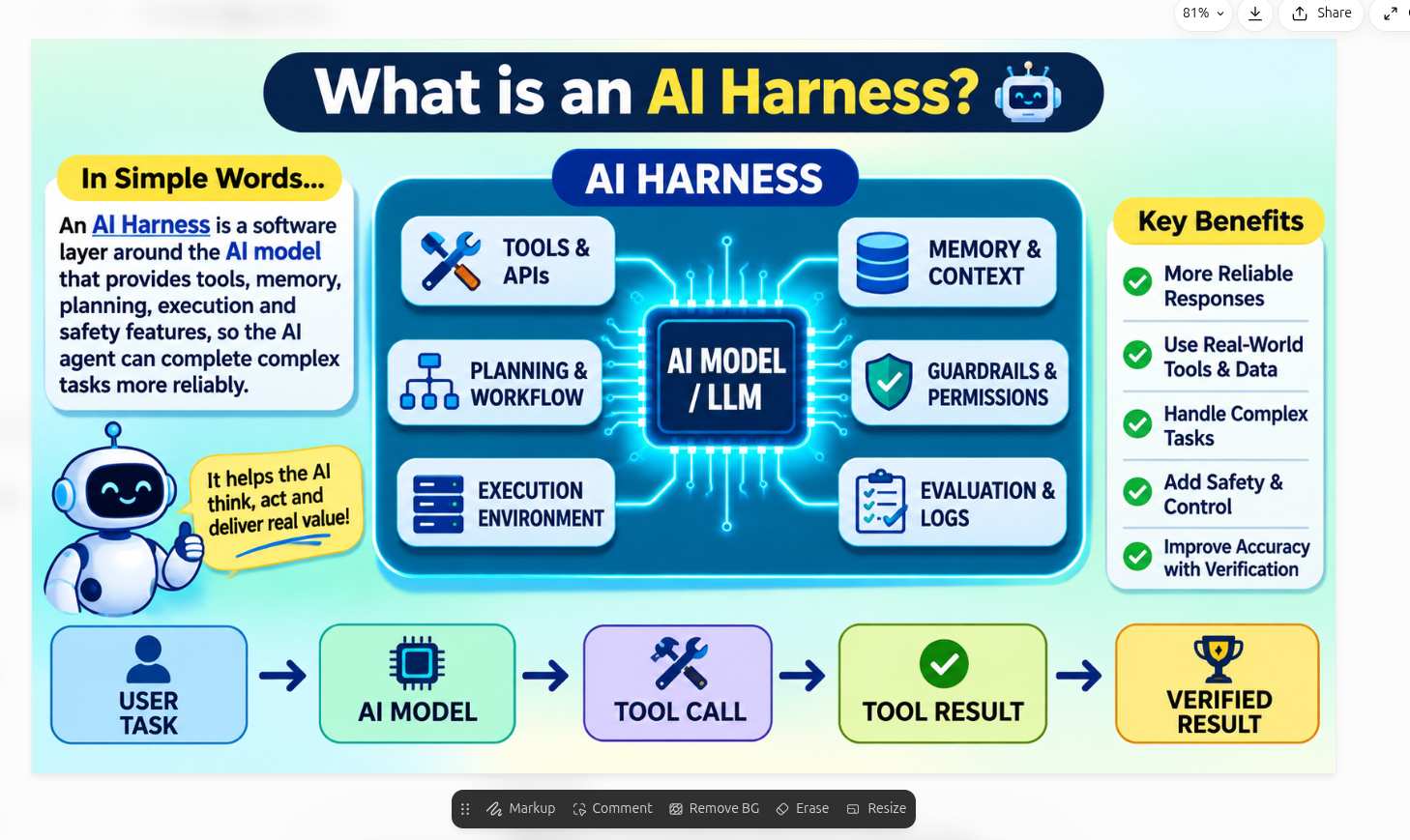
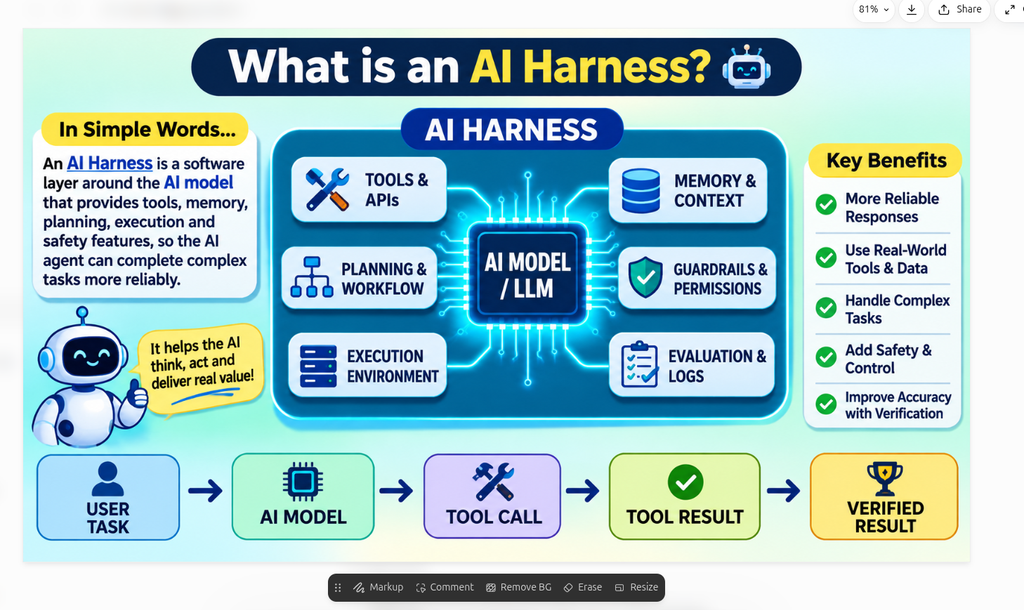
AI Harness is a framework or supporting environment that helps an AI model work effectively, safely, and reliably.
An AI model such as ChatGPT, Claude, or Gemini can understand questions and generate responses. However, to perform real-world tasks, it needs additional components such as tools, instructions, memory, security rules, workflows, and evaluation systems.
These supporting components together form an AI Harness.
In simple words:
- AI Model: The brain that thinks and generates responses.
- AI Harness: The surrounding system that controls how the AI works.
- Tools: The resources that help AI perform actions.
- Guardrails: Rules that keep AI safe and controlled.
Example: Imagine an AI coding assistant. The AI model generates code, while the harness provides access to the terminal, GitHub, files, testing tools, and security checks.
Together, they help the AI complete an entire software development task.
2. Why is AI Harness Important?
An AI model alone cannot always complete complex tasks reliably. It needs a supporting environment to manage the complete workflow.
The AI Harness helps with:
- Task Management: Breaks complex tasks into smaller steps.
- Tool Integration: Connects AI with APIs, databases, terminals, and external tools.
- Memory Management: Maintains useful context during task execution.
- Security: Controls permissions and prevents unsafe operations.
- Error Handling: Detects failures and helps AI recover.
- Evaluation: Checks whether the AI has completed the task correctly.
- Automation: Executes multiple steps with less human intervention.
3. Main Components of an AI Harness
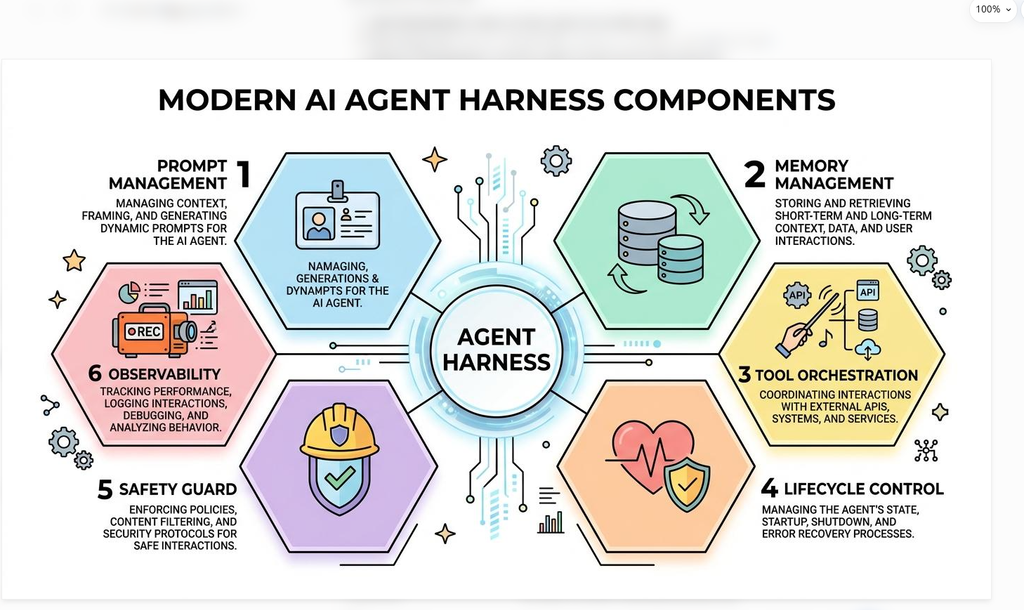
An AI Harness consists of several important components.
| Component | Purpose |
|---|---|
| AI Model / LLM | Understands instructions and makes decisions |
| Tools & APIs | Connects AI to external applications and services |
| Memory | Stores previous interactions and task information |
| Planning | Divides complex tasks into smaller steps |
| Execution Environment | Allows AI to execute commands and perform actions |
| Guardrails | Controls permissions and security |
| Evaluation | Checks output quality and task completion |
| Monitoring & Logs | Tracks activities, errors, and performance |
4. How Does an AI Harness Work?
An AI Harness generally follows a continuous execution cycle.
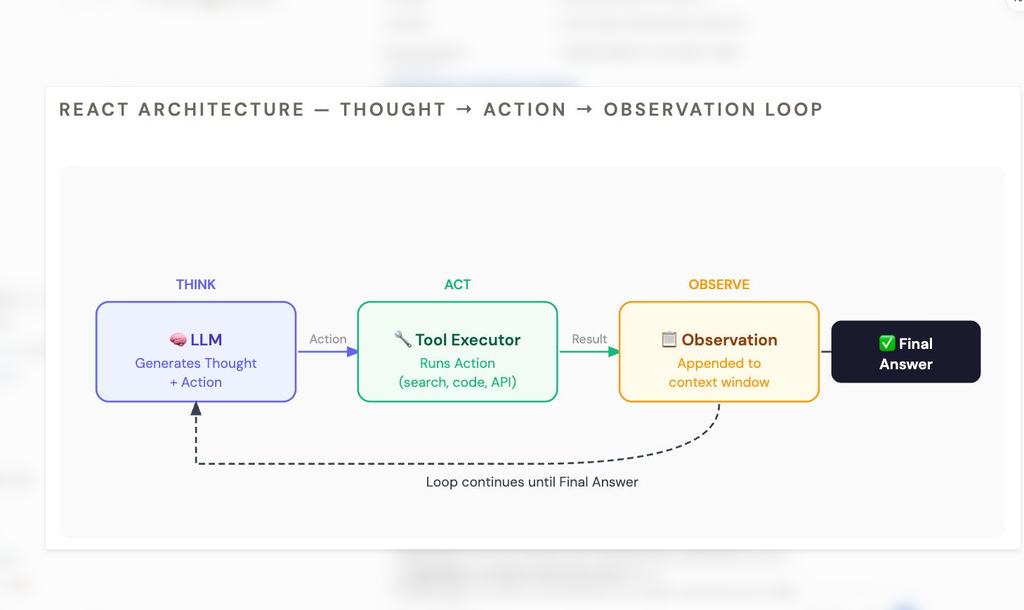
Step-by-step working:
- User Input: The user provides a task to the AI agent.
- Understanding: The AI model understands the request.
- Planning: The harness helps determine the steps needed to complete the task.
- Tool Selection: The AI selects an appropriate tool, API, or resource.
- Execution: The harness executes the requested action within its permissions.
- Observation: The result is returned to the AI model.
- Verification: The system checks whether the task was completed successfully.
- Final Output: The AI provides the result to the user.
If something fails, the harness can support retries, error handling, and recovery instead of simply stopping.
5. Real-World Example of AI Harness
Let’s understand this with a software development example.
Scenario: Fix a bug in a Java Spring Boot application.
Suppose a developer asks an AI coding agent:
“Find and fix the login API error in my Spring Boot application.”
Without an AI Harness:
- AI can suggest possible solutions.
- It may generate code.
- But it might not have access to the actual project files or testing environment.
With an AI Harness:
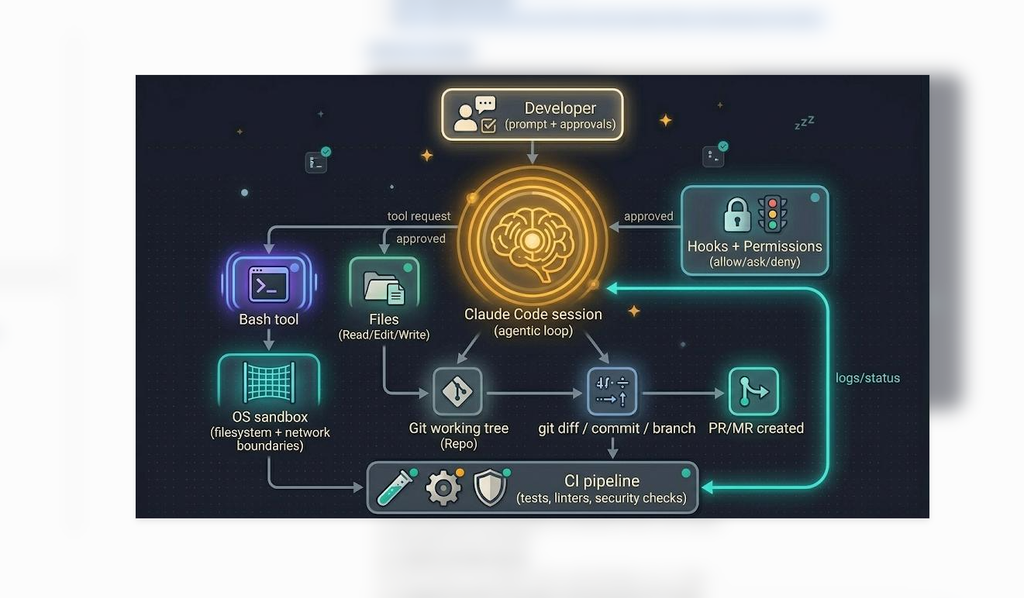
The workflow looks like this:
- AI reads the project files.
- AI identifies the login API issue.
- AI suggests and modifies the required Java code.
- The harness allows the agent to execute Maven commands.
- The agent runs unit tests.
- It checks the test results.
- If tests fail, it can inspect errors and attempt a correction.
- It presents the final changes to the developer for review.
This is a practical example of how an AI Harness makes an AI coding agent more useful.
6. AI Harness vs AI Model vs AI Agent
These three terms are related but have different responsibilities.
| Term | Meaning |
|---|---|
| AI Model | The intelligence that processes information and generates responses |
| AI Harness | The supporting software environment that manages tools, memory, execution and safety |
| AI Agent | The system that uses the model and harness to complete tasks |
A simple formula:
This is a useful conceptual model, although real-world agent architectures can contain additional components.
7. AI Harness vs Prompt Engineering vs Context Engineering
These concepts are often confused, but they solve different problems.
| Concept | Main Focus |
|---|---|
| Prompt Engineering | Writing better instructions for AI |
| Context Engineering | Providing the right information to AI |
| Harness Engineering | Building the complete supporting environment around AI agents |
Example:
- Prompt Engineering: Tell AI to fix a Java bug.
- Context Engineering: Provide the Java files, error logs, and project documentation.
- Harness Engineering: Give AI controlled file access, terminal commands, testing tools, memory, and verification mechanisms.
Harness engineering covers a broader operational environment than writing prompts alone. Thoughtworks+2
8. Where Is AI Harness Used?
AI Harness technology is useful in many industries.
Optimizing Code with AI: Techniques for Better Performance — SuperDupr
1. Software Development
Writing code, debugging applications, running tests, reviewing pull requests, and automating development workflows.
Generative AI in Customer Service: How Intelligent Agents Redefine Support and Empathy
2. Customer Support
Answering customer questions, retrieving information, creating support tickets, and managing customer requests.
3. Data Analysis
Collecting data, generating reports, identifying trends, and producing business insights.
AI SRE Agent: Automate Incident Response & Cut MTTR by 70%
4. DevOps Automation
Analyzing CI/CD failures, investigating logs, assisting with Kubernetes troubleshooting, and suggesting infrastructure fixes.
Meta Launches Business Agent AI Across Messaging Apps | The Tech Buzz
5. Business Automation
Processing documents, managing workflows, preparing reports, and automating repetitive activities.
10. Benefits of AI Harness
Some important benefits include:
- Better Productivity: Automates repetitive tasks.
- Improved Reliability: Uses validation and verification.
- Better Security: Controls which tools and resources AI can access.
- Task Automation: Supports multi-step workflows.
- Flexibility: Allows different models and tools to work together.
- Error Recovery: Helps identify and handle execution failures.
- Scalability: Supports more complex AI-powered applications.
11. Challenges of AI Harness
Although AI Harness provides many advantages, it also has some challenges:
- Security Risks: Incorrect permissions can allow unwanted actions.
- Complexity: Building and maintaining a harness requires technical knowledge.
- Cost: Multiple model calls and tool executions can increase costs.
- Debugging: Finding the cause of failures across multiple components can be difficult.
- Performance: Too many unnecessary steps can increase response time.
- Data Privacy: Sensitive information must be protected when connecting external systems.
Developers should use permission controls, isolated execution environments, logging, human approval for sensitive actions, and automated testing.
12. What Is Harness Engineering?
Harness Engineering is the process of designing, developing, testing, and improving the environment around an AI model.
Instead of only improving the AI model or changing its prompts, developers improve the tools, workflows, context, permissions, memory, and feedback mechanisms.
For example, if an AI coding agent repeatedly generates incorrect Java code, developers can improve the harness by:
- Providing project-specific coding instructions.
- Giving access to relevant project files.
- Running Maven tests automatically.
- Checking code quality.
- Recording errors.
- Requiring verification before accepting changes.
This makes the overall AI system more dependable.
13. Future of AI Harness
AI Harness technology is becoming increasingly important as AI moves from answering questions to performing real-world tasks.
In the future, AI agents may be able to:
- Develop and test complete software applications.
- Manage cloud infrastructure.
- Assist with DevOps and CI/CD pipelines.
- Analyze large datasets.
- Automate business operations.
- Coordinate multiple specialized AI agents.
However, human oversight, security, and verification will remain important.
14. Difference Between AI Harness and Harness CI/CD
This is particularly important for DevOps learners.
The word “Harness” is also the name of a software delivery platform.
Find your best CI/CD tool | GFT Technologies Poland
Harness (DevOps Platform)
A platform used for CI/CD, software delivery, cloud cost management, and related DevOps workflows.Harness official website
| AI Harness | Harness CI/CD |
|---|---|
| Architecture around AI models | DevOps software platform |
| Enables AI agents to perform tasks | Automates software delivery |
| Provides tools, memory and guardrails | Provides CI/CD and deployment workflows |
| Focuses on AI agent execution | Focuses on software delivery |
Important: AI Harness and Harness CI/CD are two different concepts. They should not be confused just because they share the word Harness.
15. Conclusion
AI Harness is an important concept in modern AI development. It provides the supporting environment that allows AI models to interact with tools, access information, execute tasks, manage memory, and verify results.
As AI agents become more powerful, harness engineering will play an important role in building secure, reliable, and scalable AI applications.
For developers, DevOps engineers, and AI enthusiasts, understanding AI Harness is a valuable step toward learning the next generation of AI-powered automation.

- What is Harness in AI? 🤖 Complete Guide to AI Harness Engineering - November 17, 2026
- What is Prompt Engineering? A Complete Beginner’s Guide - November 5, 2026
- MCP vs AI Agent: Key Differences, Architecture, Use Cases, and Examples - November 2, 2026