

Introduction:
Platform Engineering provides developers with a self-service platform to build, deploy, and manage applications efficiently.
As organizations adopt cloud-native technologies, Kubernetes, and microservices, managing infrastructure becomes increasingly complex. Development teams often spend significant time requesting environments, configuring deployments, and solving infrastructure-related issues instead of building new features.
Platform Engineering addresses this challenge by creating a standardized, self-service platform that enables developers to build, test, deploy, and operate applications efficiently.
In this beginner-friendly guide, you’ll learn what Platform Engineering is, why organizations need it, how it works, its core components, benefits, and how it differs from DevOps.
What is Platform Engineering?
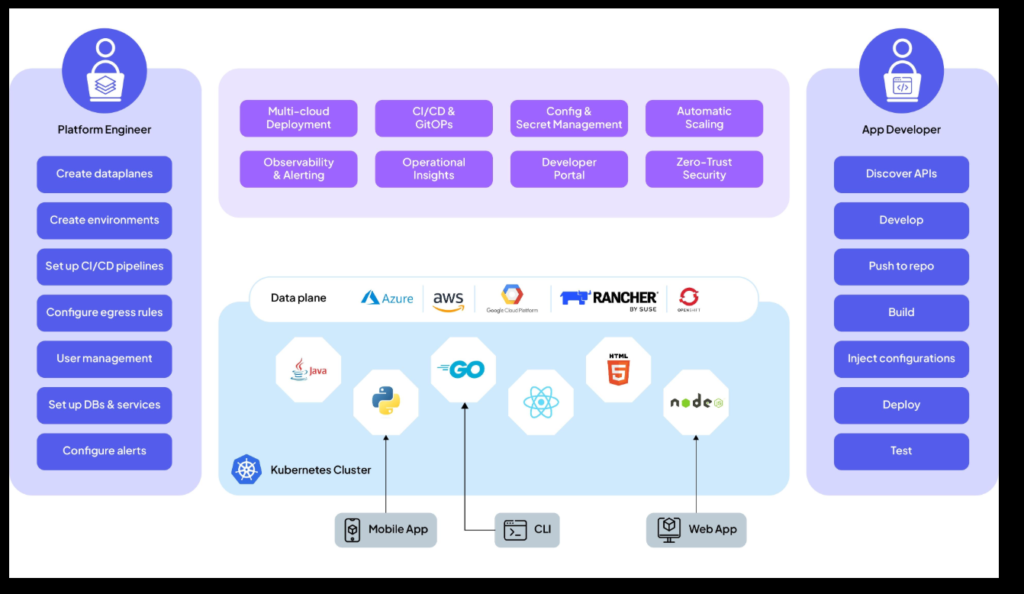
Platform Engineering is the practice of designing, building, and maintaining an Internal Developer Platform (IDP) that provides developers with self-service tools, automated workflows, and standardized infrastructure.
Instead of manually configuring servers, Kubernetes clusters, networking, CI/CD pipelines, and security for every application, developers can use a ready-made platform that automates these tasks.
Think of Platform Engineering as creating a “developer platform” where developers can deploy applications with just a few clicks or commands.
Why Do We Need Platform Engineering?
Modern software development includes many technologies such as:
- Kubernetes
- Docker
- Terraform
- CI/CD Pipelines
- Cloud Services
- Monitoring
- Security
- Secrets Management
- Networking
Developers shouldn’t have to become experts in every one of these technologies.
Without Platform Engineering:
- Every team creates its own deployment process.
- Infrastructure becomes inconsistent.
- Security policies vary.
- Application deployments become slower.
- Operational overhead increases.
Platform Engineering solves these problems by creating one standardized platform for all development teams.
Without Platform Engineering
- Different deployment methods
- Manual infrastructure setup
- Slow onboarding
- Inconsistent security
With Platform Engineering
- Self-service deployments
- Standard templates
- Faster delivery
- Built-in security
Platform Engineering Workflow
You can also present it like this:
Developer
     │
     ▼
Git Repository
     │
     ▼
CI/CD Pipeline
     │
     ▼
Docker Image
     │
     ▼
Container Registry
     │
     ▼
ArgoCD (GitOps)
     │
     ▼
Kubernetes Cluster
     │
     ▼
Monitoring & Logging
Simple Example
Imagine your company has 20 development teams.
Without Platform Engineering:
- Every team builds its own CI/CD pipeline.
- Every team writes different Kubernetes YAML files.
- Every team manages secrets differently.
- Every team configures monitoring separately.
This results in duplication, inconsistency, and maintenance challenges.
With Platform Engineering:
A dedicated Platform Team provides:
- Standard CI/CD templates
- Pre-built Kubernetes configurations
- Centralized monitoring
- Secret management
- Infrastructure templates
- Self-service deployment
Developers simply use these templates and focus on writing application code.
What is an Internal Developer Platform (IDP)?
An Internal Developer Platform (IDP) is a collection of tools, automation, and reusable templates that simplify software development and deployment.
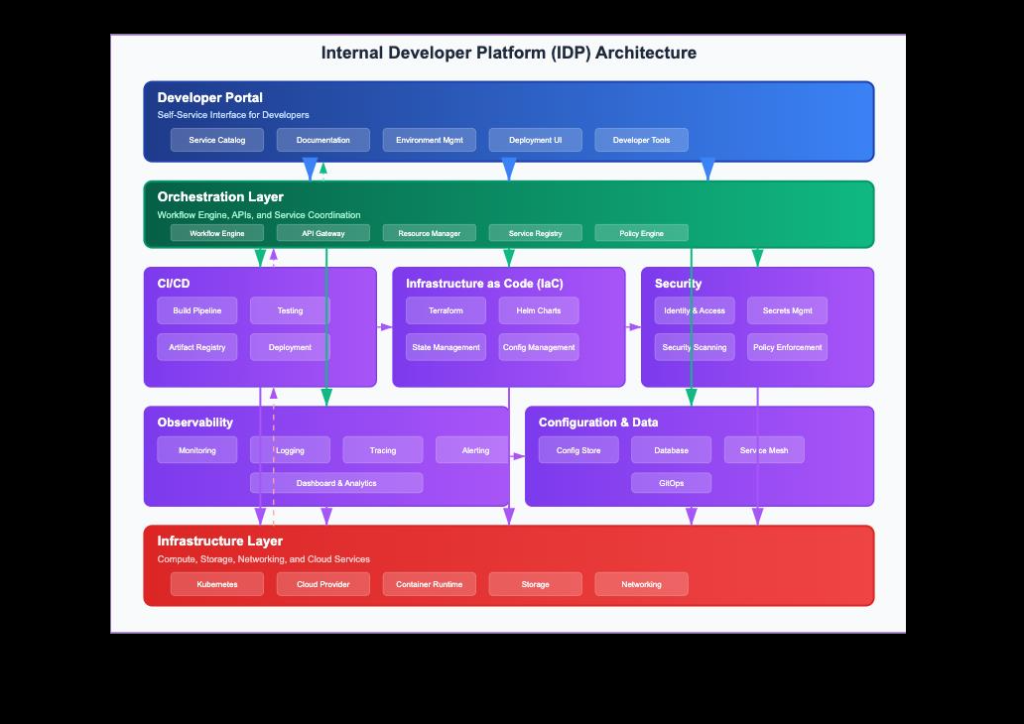
It typically provides:
- Self-service deployments
- Automated infrastructure provisioning
- CI/CD pipelines
- Kubernetes deployment templates
- Logging
- Monitoring
- Security policies
- Secrets management
- Developer documentation
Developers interact with the platform instead of manually managing infrastructure.
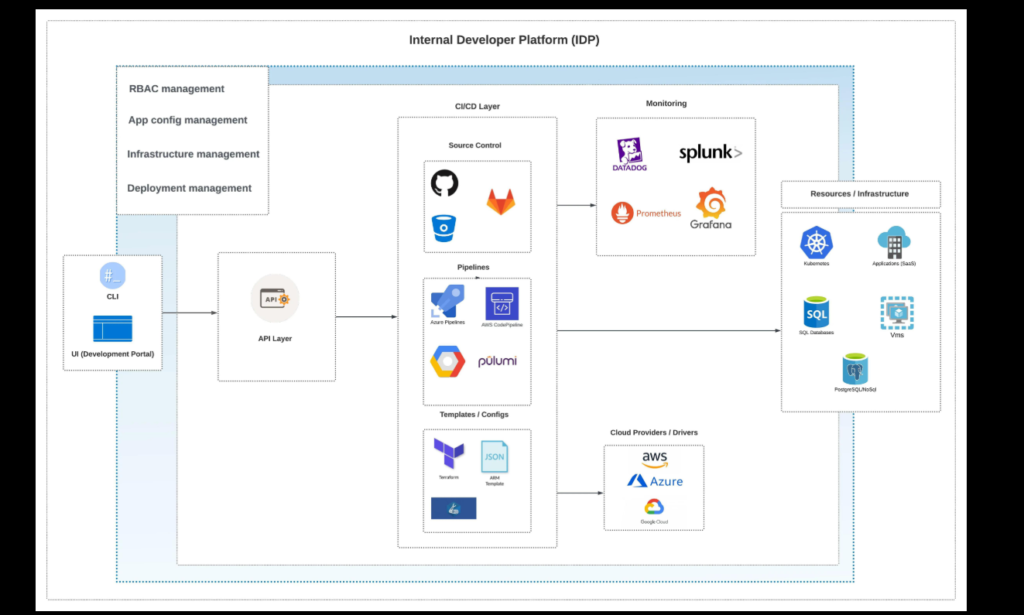
Key Components of Platform Engineering
1.Self-Service Infrastructure
Developers can provision environments without opening tickets or waiting for operations teams.
Example:
- Create a Kubernetes namespace
- Provision a database
- Deploy an application
- Request cloud resources
Everything is automated.
2.Infrastructure as Code (IaC)
Infrastructure is managed using code instead of manual configuration.
Popular tools include:
- Terraform
- OpenTofu
- Pulumi
- Crossplane
Benefits include consistency, repeatability, and version control.
3.CI/CD Automation
Platform engineers provide reusable CI/CD pipelines that automate:
- Source code checkout
- Build
- Testing
- Security scanning
- Docker image creation
- Deployment
Developers use the pipeline without recreating it.
Popular tools:
- GitHub Actions
- Jenkins
- GitLab CI
- Azure DevOps
4.Kubernetes Platform
Instead of manually creating Kubernetes manifests for every project, Platform Engineering offers reusable Helm charts, deployment templates, and standardized cluster configurations.
Benefits include:
- Standard deployments
- Easier upgrades
- Better security
- Faster onboarding
5.Developer Portal
A Developer Portal is a centralized interface where developers can:
- Create projects
- Deploy applications
- View documentation
- Access APIs
- Manage environments
- Track deployments
A popular example is Backstage.
6.Monitoring and Observability
The platform includes built-in monitoring and logging so developers can easily observe application health.
Common tools include:
- Prometheus
- Grafana
- Loki
- OpenTelemetry
7.Security
Security is built into the platform from the beginning.
Examples include:
- Secret management
- RBAC
- Image scanning
- Policy enforcement
- Identity management
This reduces security risks while simplifying compliance.
Benefits of Platform Engineering:
Organizations adopting Platform Engineering often experience:
- Faster software delivery
- Improved developer productivity
- Standardized infrastructure
- Better security
- Reduced operational overhead
- Easier onboarding
- Consistent deployments
- Lower maintenance costs
- Increased reliability
- Better scalability
Popular Platform Engineering Tools
| Category | Tools |
|---|
| Container Platform | Kubernetes |
| Container Runtime | Docker |
| Infrastructure as Code | Terraform, OpenTofu, Pulumi |
| GitOps | Argo CD, Flux |
| CI/CD | Jenkins, GitHub Actions, GitLab CI |
| Package Management | Helm |
| Developer Portal | Backstage |
| Secrets Management | HashiCorp Vault |
| Monitoring | Prometheus, Grafana |
| Logging | Loki, ELK Stack |
| Service Mesh | Istio, Linkerd |
Platform Engineering Workflow:
A typical workflow looks like this:
- Developer writes code.
- Code is pushed to Git.
- CI/CD pipeline starts automatically.
- Tests and security checks run.
- Docker image is built.
- Image is stored in a container registry.
- GitOps updates Kubernetes manifests.
- Argo CD deploys the application.
- Monitoring dashboards track application health.
- Developers observe logs and metrics through the platform.
Platform Engineering vs DevOps
| Feature | DevOps | Platform Engineering |
| Goal | Faster software delivery | Better developer experience |
| Primary Users | Developers and Operations | Developers |
| Focus | Automation and collaboration | Self-service platform |
| Deliverables | CI/CD pipelines and automation | Internal Developer Platform |
| Infrastructure | Managed by DevOps | Abstracted behind reusable services |
| Success Metric | Faster releases | Higher developer productivity |
Real-World Example
Imagine an e-commerce company with hundreds of developers.
The Platform Engineering team builds:
- Kubernetes platform
- Standard CI/CD pipelines
- Helm chart templates
- Monitoring dashboards
- Secret management
- Deployment automation
- Developer documentation
Now, when a developer creates a new application, they don’t need to configure infrastructure manually. They simply use the platform’s templates, and deployment becomes a standardized, automated process.
Best Practices
- Automate repetitive tasks.
- Build reusable templates.
- Provide self-service capabilities.
- Treat infrastructure as code.
- Embed security into the platform.
- Standardize CI/CD pipelines.
- Continuously monitor platform performance.
- Maintain clear documentation.
- Gather developer feedback and improve the platform regularly.
Conclusion
Platform Engineering has become a key practice for organizations adopting cloud-native technologies. By building an Internal Developer Platform, teams can reduce operational complexity, improve consistency, and allow developers to focus on delivering business value instead of managing infrastructure.
- Platform Engineering simplifies software delivery by providing developers with self-service tools and automated workflows.
- Internal Developer Platforms (IDPs) eliminate repetitive infrastructure tasks, enabling developers to spend more time writing application code.
- Standardization improves quality by ensuring that every application follows the same deployment, security, monitoring, and compliance practices.
- Automation reduces human error through Infrastructure as Code (IaC), CI/CD pipelines, GitOps, and reusable templates.
- Developer productivity increases because developers no longer need deep expertise in Kubernetes, cloud infrastructure, or networking to deploy applications.
- Security is built into the platform with centralized secrets management, policy enforcement, access control, and automated security checks.
- Organizations achieve faster releases while maintaining consistent, reliable, and scalable infrastructure across multiple teams.
- Platform Engineering complements DevOps by building reusable platforms that make DevOps practices easier to adopt and scale across the organization.
- Modern tools such as Kubernetes, Terraform, Helm, Argo CD, Backstage, Prometheus, and Grafana are commonly used to build robust platform engineering ecosystems.
- As organizations scale, Platform Engineering becomes a strategic investment, helping improve developer experience, reduce operational costs, and accelerate innovation.

- How to Create a Server on AWS – Step-by-Step Guide for Beginners - September 2, 2026
- Helm GitOps Integration: A Complete Step-by-Step Guide for Beginners - August 6, 2026
- DevOps Engineer vs Platform Engineer vs Site Reliability Engineer (SRE) - August 4, 2026