

What is Site Reliability Engineering (SRE)?
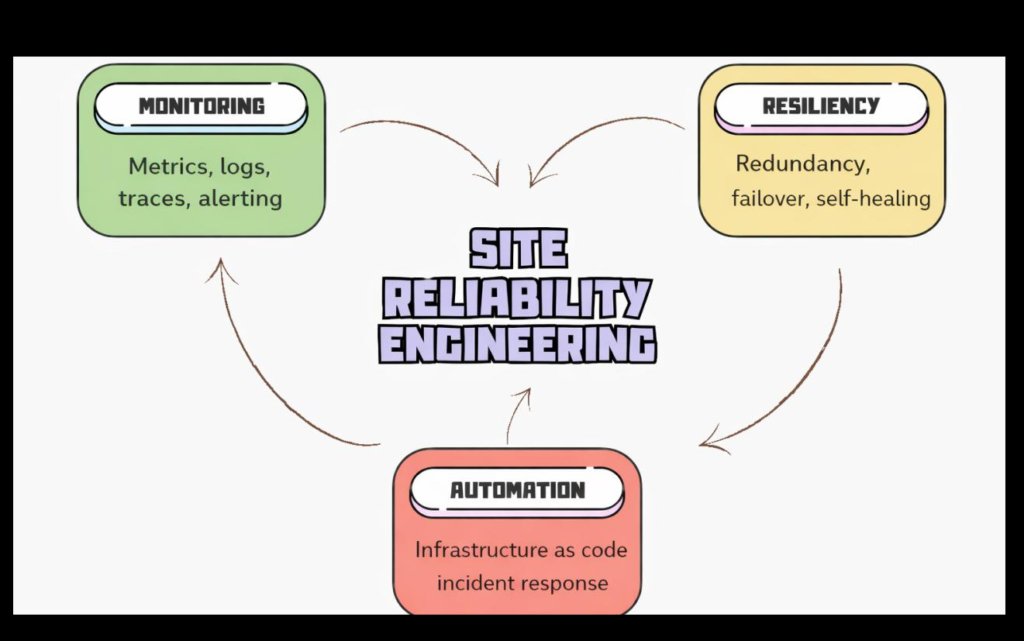
Site Reliability Engineering (SRE) is a software engineering approach to IT operations that focuses on building and maintaining highly reliable, scalable, and automated systems. Instead of relying on manual operational tasks, SRE uses automation, monitoring, and engineering practices to ensure applications remain available, performant, and resilient.
Google introduced SRE in 2003, and it has since become a standard practice for managing cloud-native applications and large-scale distributed systems.
Introduction to SRE:
Definition:
Site Reliability Engineering (SRE) is the practice of applying software engineering principles to infrastructure and operations to improve:
SRE ensures that applications remain available, reliable, and fast while reducing manual operational work through automation.
- High Availability
- Reliability
- Scalability
- Performance
- Automation
- Security
- Cost Optimization
History of SRE:
Introduced by Google
- Created in 2003
- Invented by Ben Treynor Sloss
- Developed for managing Google’s large-scale infrastructure
Famous Definition
“SRE is what happens when you ask a software engineer to design an operations team.”
Why is SRE Important?
Modern applications serve millions of users every day. Any downtime can lead to revenue loss and poor customer experience.
Without SRE
- Frequent outages
- Slow deployments
- Manual operations
- Human errors
- High operational costs
- Poor monitoring
- Slow recovery
With SRE
- Better automation
- Faster deployments
- Reliable applications
- Continuous monitoring
- Automatic recovery
- Improved customer satisfaction
Core Principles of SRE:
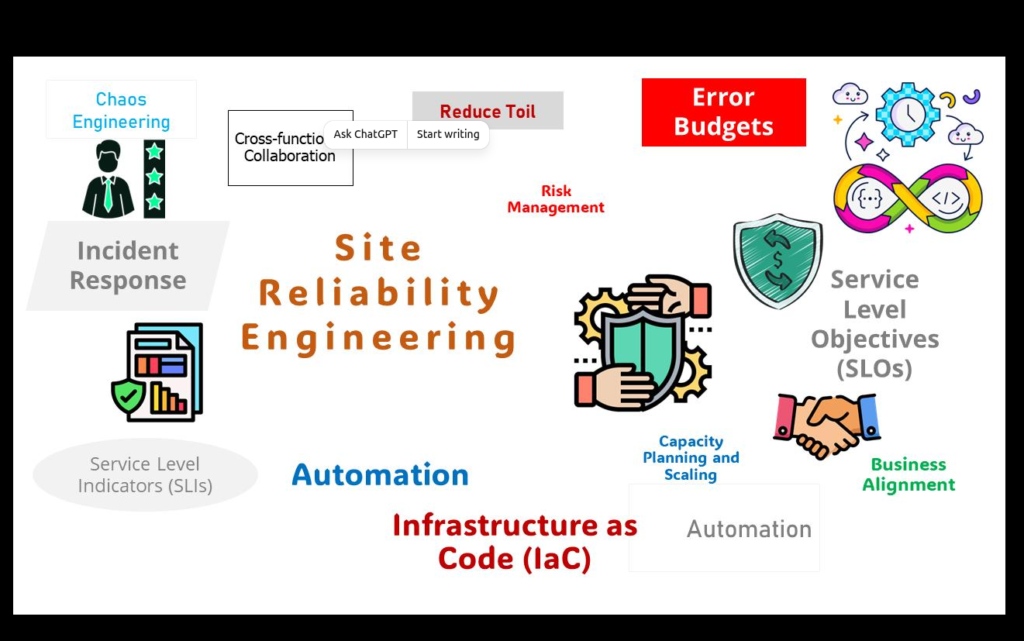
1.Automation First
Automate repetitive tasks such as:
- Server provisioning
- Deployments
- Backups
- Scaling
- Monitoring
- Security patching
2. Reliability
Focus on:
- High availability
- Low downtime
- Fault tolerance
- Disaster recovery
3. Monitoring Everything
Monitor:
- CPU
- Memory
- Disk
- Network
- Kubernetes
- Docker
- Applications
- APIs
- Databases
4. Reduce Toil
Toil means repetitive manual work.
Examples:
- Manual deployment
- Restarting servers
- Log collection
- Manual scaling
Goal:
Automate everything possible.
5. Measure Reliability
Key metrics:
- Availability
- Latency
- Error Rate
- Throughput
5. Goals of SRE
Main objectives include:
- Improve application uptime
- Reduce downtime
- Increase automation
- Improve scalability
- Reduce operational costs
- Improve deployment success rate
- Enhance customer experience
- Faster incident response
- Better monitoring
- Continuous improvement
6. Roles and Responsibilities
Daily Responsibilities
- Infrastructure Monitoring
- Incident Management
- Capacity Planning
- CI/CD Support
- Kubernetes Management
- Cloud Infrastructure
- Infrastructure Automation
- Security Monitoring
- Performance Optimization
- Backup & Disaster Recovery
7.SLI, SLO & SLA
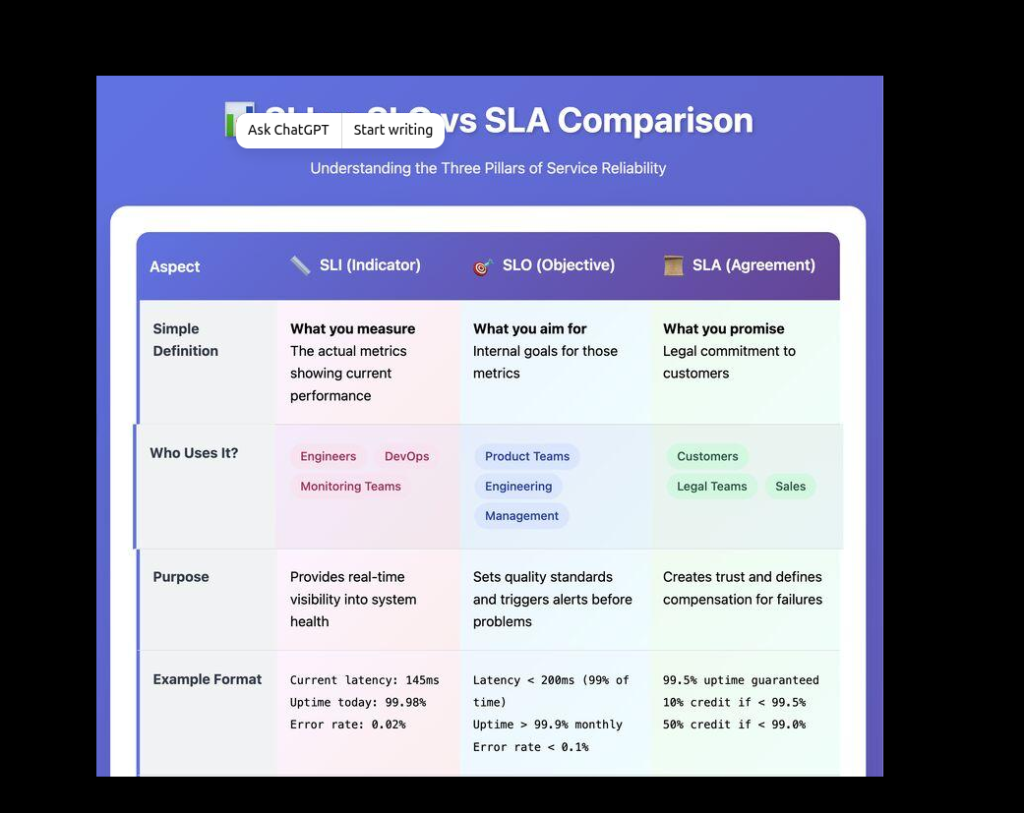
SLI (Service Level Indicator)
Measures actual system performance.
Examples:
- Availability
- Latency
- Error Rate
- Success Rate
Example:
99.95% Successful Requests
SLO (Service Level Objective)
Defines the target performance.
Example:
99.9% Uptime
SLA (Service Level Agreement)
Agreement between provider and customer.
Example:
99.99% AvailabilityIf violated:
- Service Credit
- Refund
- Compensation
8. What is Error Budget?
An Error Budget is the amount of downtime or failure that is acceptable while still meeting the SLO.
Example:
SLO = 99.9% Uptime
Allowed downtime:
- Around 43 minutes per month
If the error budget is exhausted:
- Stop new releases
- Fix reliability issues
- Improve monitoring
- Increase automation
9.Monitoring & Observability

Three Pillars of Observability
Metrics
Examples:
- CPU Usage
- Memory Usage
- Network Usage
- Request Count
Logs
Examples:
- Application Logs
- System Logs
- Security Logs
Traces
Track requests across microservices to identify bottlenecks and latency.
10. Incident Management
Incident Workflow
Issue Detected
       ↓
Alert Generated
       ↓
Engineer Assigned
       ↓
Investigation
       ↓
Root Cause Analysis
       ↓
Fix Applied
       ↓
Monitoring
       ↓
Postmortem
11.Automation in SRE
Tasks commonly automated:
- Infrastructure Provisioning
- Deployments
- Auto Scaling
- Health Checks
- Backups
- Disaster Recovery
- Security Scanning
- Log Collection
- Alerting
- Monitoring
Popular SRE Tools:
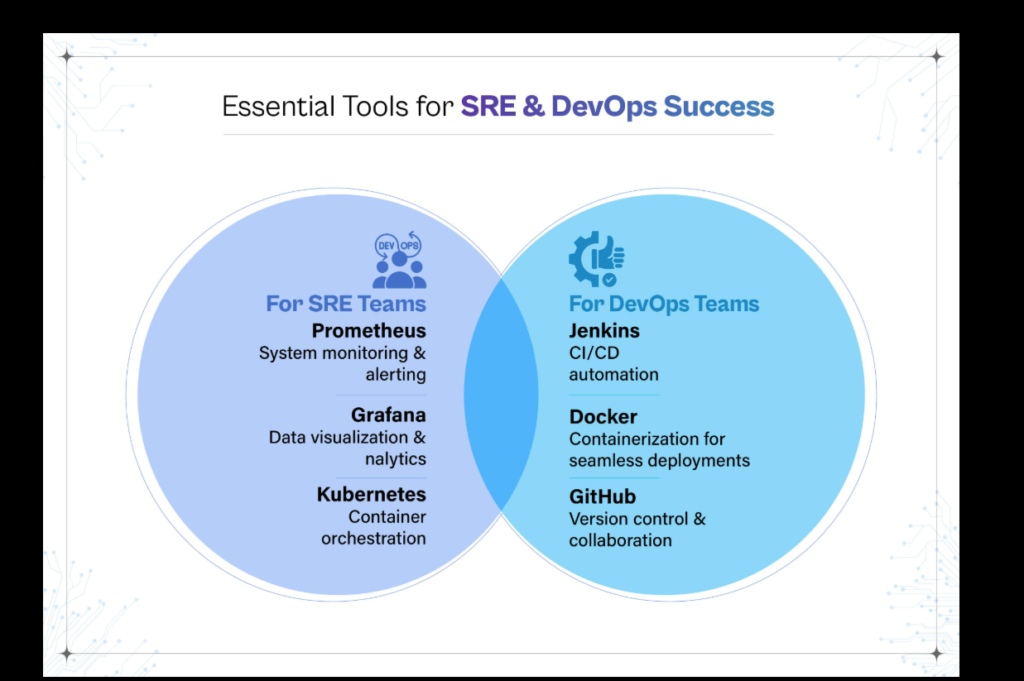
| Category | Popular Tools |
|---|---|
| Monitoring | Prometheus, Grafana |
| Logging | ELK Stack, Loki |
| Tracing | Jaeger, Zipkin |
| Containers | Docker |
| Orchestration | Kubernetes |
| IaC | Terraform |
| Configuration | Ansible |
| CI/CD | Jenkins, GitHub Actions |
| Cloud | AWS, Azure, Google Cloud |
| Alerting | Alertmanager, PagerDuty |
SRE Lifecycle:
Design

↓

Build

↓

Deploy

↓

Monitor

↓

Alert

↓

Investigate

↓

Fix

↓

Postmortem

↓

Automate

↓

Improve
Benefits of SRE:
- High Availability
- Reduced Downtime
- Better Monitoring
- Faster Incident Resolution
- Automated Operations
- Improved Scalability
- Better Customer Experience
- Cost Optimization
- Reliable Deployments
- Increased Productivity
Challenges of SRE
- Complex Infrastructure
- Alert Fatigue
- Legacy Systems
- Cloud Cost Management
- Continuous Monitoring
- Skill Gap
- High Operational Complexity
Conclusion
- Site Reliability Engineering (SRE) is a discipline that applies software engineering principles to IT operations to build reliable, scalable, and highly available systems.
- SRE focuses on reducing downtime by automating repetitive operational tasks and minimizing manual intervention.
- The core objective of SRE is to strike the right balance between rapid software delivery and system reliability.
- Key concepts such as SLIs (Service Level Indicators), SLOs (Service Level Objectives), SLAs (Service Level Agreements), and Error Budgets help teams measure and maintain service reliability.
- Continuous monitoring, logging, tracing, and observability enable SRE teams to detect issues early and resolve incidents quickly.
- Automation plays a crucial role in SRE by streamlining deployments, scaling infrastructure, backups, recovery, and routine maintenance tasks.
- SRE complements DevOps by adding a strong emphasis on measurable reliability, operational excellence, and data-driven decision-making.
- Organizations that adopt SRE practices benefit from higher uptime, improved performance, faster incident resolution, lower operational costs, and enhanced customer satisfaction.
- Modern technologies such as Docker, Kubernetes, Terraform, Prometheus, Grafana, Jenkins, and cloud platforms are widely used to implement SRE practices effectively.
- As businesses continue adopting cloud-native architectures and microservices, SRE has become one of the most valuable and in-demand career paths for DevOps and cloud professionals.
- Implementing SRE is not just about maintaining infrastructure—it is about building resilient, efficient, and continuously improving systems that can support business growth and deliver exceptional user experiences.
- By embracing SRE principles and best practices, organizations can achieve greater reliability, scalability, operational efficiency, and long-term success in today’s fast-paced digital landscape.

- How to Create a Server on AWS – Step-by-Step Guide for Beginners - September 2, 2026
- Helm GitOps Integration: A Complete Step-by-Step Guide for Beginners - August 6, 2026
- DevOps Engineer vs Platform Engineer vs Site Reliability Engineer (SRE) - August 4, 2026